
Are you accidentally breaking the law?
Feb 18, 2026I'm The Real Jason Duncan, back with another edition of Beyond the Grind – helping entrepreneurs like you stop being slaves to your businesses. 🚀
Over the past two editions, I've introduced you to two laws.
The Law of the Prisoner – how I built a million-dollar trap and discovered my business was worthless because I was stuck at the center of it.
The Law of the Architect – the three roles that actually matter for a founder who wants to own something valuable instead of just operating something busy.
Now, we find out which law you're actually living by...and which one you’re breaking (maybe even both!).
And I'll warn you now: this one might sting a little.
The Real Problem
Most entrepreneurs who've read the books and attended the conferences and listened to the podcasts think they're architects.
They've hired some people.
They've built some systems.
They've delegated some tasks.
Things feel better than they used to.
And here's the dangerous part: they're right that they've made progress.
The problem is that feeling like an architect and actually being one are two completely different things, and the gap between them is where entrepreneurs go to die – or at least to stay stuck for another decade while telling themselves they're almost there.
I teach something called the Three Tiers of Entrepreneurial Evolution, and understanding where you actually sit on this framework is the most honest assessment you can do for yourself.
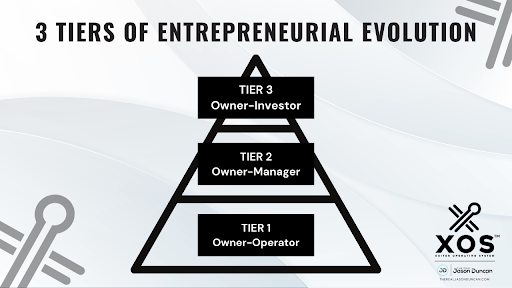
Tier 1 is the Owner-Operator.
You ARE the business – every decision flows through you, every problem lands on your desk, and if you stop working the business stops generating revenue.
This is the Law of the Prisoner in its purest form.
Tier 3 is the Owner-Investor.
Your business operates independently of your daily involvement, your team runs operations and makes decisions without you, and you focus only on the three jobs of the Architect: set the vision, communicate the vision, build the asset.
This is freedom.
But here's what most people don't understand: Tier 2 – the Owner-Manager – is actually the most dangerous position of all.
Why This Matters
Tier 2 feels like progress because it is progress.
You have a team now.
You've delegated tasks.
You're not doing everything yourself anymore.
Things function for a little while when you step away, even if they pile up and you come back to a mess.
And because it feels better than Tier 1, you get lulled into a false sense of comfort thinking you've built something valuable.
You haven't.
Not yet.
Here's what the data shows: 83% of businesses listed for sale never sell.
Let that sink in for a second – the vast majority of business owners who decide they're ready to exit discover that nobody wants what they've built.
And 75% of those failures are due to one thing: owner dependency.
The business needs the owner too much, and investors aren't stupid.
They know that if you leave, the thing falls apart.
So either they don't buy at all, or they buy at a massive discount and require you to stick around for three to five years to make sure the transition doesn't destroy what they just paid for.
That's called an earn-out, and I have personal experience with how miserable that arrangement can be.
I've also watched clients go through eight-figure earn-outs – deals that looked incredible on paper, life-changing money, the kind of exit you're supposed to celebrate – and they absolutely hated their lives for years afterward because they were trapped in a business they no longer owned but couldn't leave.
That's not an exit.
That's a prison sentence with better furniture.
And here's the brutal truth: most Tier 2 entrepreneurs either don't sell at all, or they sell with an earn-out because their business isn't valuable enough without them to command a clean break.
Owner-dependent businesses sell for 50-70% less than they should – if they sell at all.
Tier 2 entrepreneurs look at their team and their systems and think they've built something worth owning.
Investors look at the same business and see something that requires a discount because the founder is still the bottleneck.
The Diagnostic
I once did a training for my mastermind members and their A-team leaders – the key employees who make their businesses run.
I gave every A-team member permission to ask their boss one question whenever they see the boss stepping outside the lane they're supposed to operate in.
The question is simple: “Is this one of your three?”
The three jobs of the Architect: set the vision, communicate the vision, build the asset.
If what you're doing right now isn't one of those three things, you're not being an architect – you're being a prisoner who happens to have employees.
When your team asks you that question (and if you're doing this right, you'll give them permission to ask it), you have two options.
-
Option one: recognize that you've slipped back into old patterns, thank them for the accountability, and step back.
-
Option two: explain how what you're doing actually IS one of your three – because sometimes it is, and they just can't see the full picture.
Either way, the question forces you to honestly assess what you're doing with your time.
Here's my personal signal that I've slipped: when I feel overwhelmed with tasks.
Because as an architect, I shouldn't be overwhelmed with tasks.
If I'm overwhelmed by anything, it should be the challenge of growth – figuring out how to make sure the vision is meeting the strategy my team is implementing.
Not tasks.
Tasks are for people who work in the business.
Architects work on the business.
When I'm drowning in tasks, that's the clearest indication I'm working on the wrong things, and it happens more often than I'd like to admit because old habits don't die – they just wait for stressful moments to resurrect themselves.
Now What?
Here's a quick self-assessment you can do right now.
Think about how you spent your time this past week and answer honestly:
-
How many hours did you spend setting or refining your vision?
-
How many hours did you spend communicating that vision to your team, your clients, your market?
-
How many hours did you spend on work that builds your business as an asset – work that makes the company more valuable whether you're there or not?
-
Now add up all the other hours – the emails, the meetings, the decisions that should belong to someone else, the fires, the tasks.
If the first three numbers are tiny compared to the last one, you're living by the Law of the Prisoner no matter what title you've given yourself.
Words of Wisdom
“There is a way that appears to be right, but in the end it leads to death.” – Proverb 14:12
Tier 2 appears to be right.
You've made progress.
Things are better.
You have a team and systems and it feels like you're almost there.
But “almost there” is where entrepreneurs get stuck for years, sometimes decades, sometimes forever.
The way that appears to be right – delegating tasks while holding onto decisions, building a team while remaining the bottleneck, feeling like an architect while living like a prisoner – leads somewhere you don't want to go.
It leads to an unsellable business, or a discounted sale, or an earn-out that traps you for years after you thought you were free.
The way that actually works is harder and scarier.
It requires letting go of things you've always held.
It requires trusting people in ways that feel risky.
It requires asking yourself "Is this one of my three?" and being honest about the answer even when you don't like it.
But it's the only way that leads to freedom.
Until next time...
Go beyond the grind,
The Real Jason Duncan 🚀
P.S. Next, I'm going to give you the escape plan – seven specific shifts that move you from Prisoner to Architect. We've diagnosed the problem. Now we fix it.
